East Hampton
American PsychoEast Hampton functions as both an elite retreat and a pressure chamber in Patrick Bateman’s trajectory. The house belonging to Timothy Price offers privacy, wealth, and escape from Manhattan, yet its enormous spaces become the setting for Bateman’s escalating violence and emotional vacancy. The location therefore exposes the instability beneath the polished routines of Wall Street privilege: removal from the city does not restore humanity, but gives Bateman’s impulses room to expand.
Ownership and Setting
East Hampton enters the narrative as the destination Patrick Bateman believes he needs after his nightly bloodlust begins to overflow into his daytime life. He proposes leaving the city for a vacation, and Evelyn Richards accepts the suggestion. The property is actually Timothy Price’s, although Evelyn has the keys for reasons Bateman does not investigate. That unexplained access reinforces the closed social world in which wealth, houses, keys, and private arrangements circulate with little practical resistance.
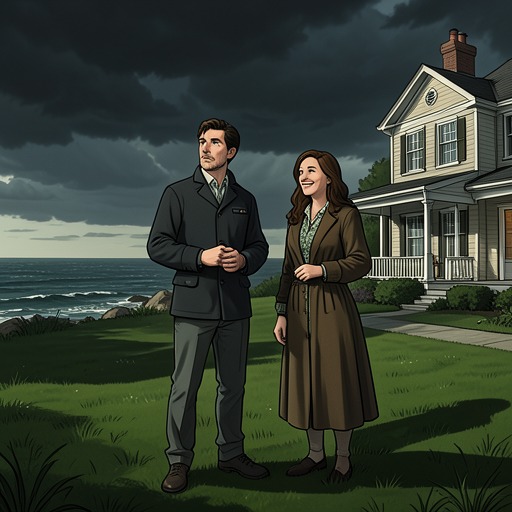
Price’s house stands on the water and rises four stories, its many gable roofs joined by a galvanized-steel staircase. The scale is immediately excessive. Its one-thousand-square-foot kitchen is designed in minimalist fashion, with two huge ovens, massive cupboards, a walk-in freezer, a three-door refrigerator, and a custom stainless-steel island dividing the room into three areas. Nine bathrooms contain a mixture of trompe l’oeil paintings and antique lead ram’s heads whose mouths spout water over the sinks; the sinks, bathtubs, and showers are antique marble, while the floors are covered in tiny marble mosaics.
The house’s catalog of possessions turns domestic life into an inventory of status. Every room has a stereo, and the property contains twelve Frank Lloyd Wright standing lamps, fourteen Josef Heffermann club chairs, floor-to-ceiling videocassette cases, thousands of compact discs behind glass, an Eric Schmidt chandelier, an Atomic Ironworks steel moose hatrack, an old Russian dining table without chairs, and walls lined with photographs by Cindy Sherman. An exercise room, eight walk-in closets, five VCRs, a Noguchi glass-and-walnut dining table, a fax machine, a tennis court, two saunas, and an indoor Jacuzzi in a guesthouse extend the same logic of abundance into leisure and self-care.
Retreat from Manhattan
East Hampton is presented as a spatial counterpart to the Manhattan circuits through which Bateman normally moves. In the city, his world is organized by restaurants, offices, clubs, banks, gyms, limousines, and automatic teller machines. Wall Street gives way to a private waterfront estate, but the underlying system remains recognizable: money is expressed through architecture, branded objects, controlled access, and the ability to withdraw from ordinary public life.
The contrast with Manhattan also clarifies the social boundaries that structure Bateman’s movement. In the city, he passes from Wall Street traffic and expensive restaurants to streets marked by graffiti, garbage, drug dealing, and homelessness. He later walks through the antique district below Fourteenth Street, where empty streets, a church, a diner, taxis, steam, and frozen garbage produce a starkly different urban landscape. At Central Park Zoo, the skyline and Fifth Avenue buildings surround an environment that seems unnatural and enclosed. East Hampton offers another form of enclosure: not poverty and exposure, but privilege, distance, and architectural insulation.
The retreat does not produce a meaningful change in Bateman’s conduct. In the city, luxury repeatedly exists beside visible deprivation: after a $475 meal at Pastels, he and his companions encounter a homeless man asking for change and food. East Hampton removes that immediate public contrast without removing the moral structure that made it possible. The house becomes a protected zone in which wealth can conceal consequences rather than eliminate them.
Violence within the House
The physical magnificence of the property provides the background for Bateman’s increasing inability to maintain an ordinary persona. While Evelyn Richards is away, he vomits into the rustic terra-cotta jars lining the patio, drives into town with the masseur to collect razor blades, and places a faux-concrete and aluminum-wire sconce over Evelyn’s head while she is unconscious from Halcion. At first he laughs as the sconce rises and falls with her breathing; then the act makes him sad, and he stops doing it. The moment is not a recovery of compassion so much as a brief, unstable interruption in his practiced cruelty.
The house also contains a dog that Bateman eventually drowns. Evelyn fails to notice the animal’s absence, even when he puts it in the walk-in freezer wrapped in one of her Bergdorf Goodman sweaters. The freezer, introduced as one more feature of the monumental kitchen, consequently becomes an instrument of concealment. A luxury amenity is converted into part of the machinery of violence, showing how the house’s objects participate in Bateman’s disordered private world.
The danger finally makes continued residence impossible. Bateman finds himself standing over the bed before dawn with an ice pick in his fist, waiting for Evelyn to open her eyes. The threat remains poised rather than fully enacted, but its recurrence changes the meaning of the retreat: the private house can no longer be treated as a vacation home or a neutral refuge. At Bateman’s suggestion, Evelyn agrees to leave, and they return to Manhattan by helicopter on the last Sunday before Labor Day.
Return and Narrative Significance
The return to Manhattan marks East Hampton as a failed escape. Bateman has sought distance because his violence has become difficult to contain, but the isolation of Price’s house only allows the impulses to become more intimate and sustained. The helicopter departure restores the city as the narrative’s principal arena, yet it does not resolve the condition that prompted the retreat.
East Hampton’s significance lies in this reversal. A house filled with marble, custom steel, designer furniture, saunas, music, video, and carefully controlled spaces should represent mastery over the environment. Instead, its abundance becomes strangely inert beside Bateman’s depersonalization. He describes himself as possessing the physical characteristics of a human being while lacking ordinary compassion, and the house’s polished surfaces mirror that condition: everything is present, finished, and expensive, but nothing guarantees feeling or moral order.
The location also intensifies the book’s contrast between appearance and reality. East Hampton looks like an ideal of cultivated leisure, but within it Bateman vomits, gathers razor blades, threatens Evelyn, and disposes of the dog. The retreat therefore does not interrupt the violence that defines his existence; it strips away the public performance that usually disguises it. When Bateman returns to Manhattan, East Hampton remains behind as evidence that neither luxury nor seclusion can provide an exit from the self he has constructed.